
Qinghai Cheats
We cheated getting to Qinghai but for all the right reasons

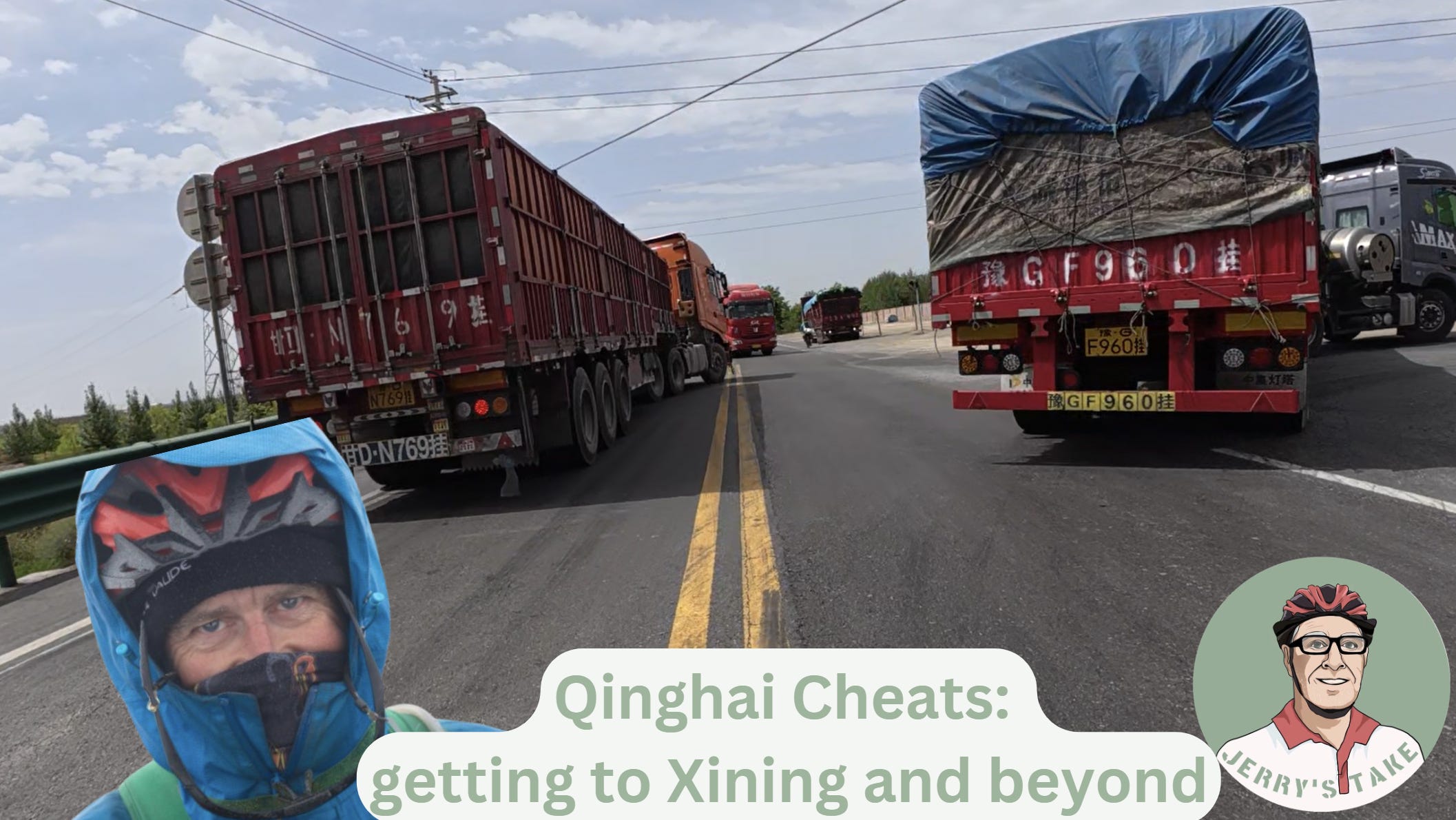
Today I finally ticked off a box that I’ve been working on since I arrived in China in 2004 - I’ve now visited every province, and region managed by the People’s Republic of China - are in Qinghai and spending a couple of nights here before starting phase two of this journey, the route across the Tibetan Plateau to enter Xinjiang from the South.
Most people are not all that familiar with China’s geography so here’s a short lesson - Xining is on the lower edge of the Plateau at only 2,500m. Parts of the Plateau are much higher but for the most part, we will be travelling in regions that are around 3,500m. Even in summer, it’s cool here, at night it will be in single digits Celsius and rarely above 20C or for the Americans in the audience, that’s between 50 and 68 for at least the next three weeks.
We have 1,900 kilometres to go until we are in Xinjiang and ending this phase but, when we arrive in Xinjiang we need to descend from what is the world’s largest high plateau to the second lowest point on planet earth and we will enter the Tarim Basin in the height of summer, with a descent of over 3,500 metres we will then hit extreme temperatures of around 40-45C, meaning it will be well over 100f.
But that’s all to come and, hopefully, when we get to the other end, we’ll show you some of the adventures we had getting there - there are now four of us on the team, Ann, Bev and I have been joined by a YouTube follower of mine who wanted to try one of these adventures and asked if he could meet us and join for a while - so, on arrival in Xining, we welcomed Kuan to the team and no doubt, you’ll be seeing something of him in future videos.
For now though, it’s time to talk about how we got into Xining, leaving Ningxia, one of my favourite regions of China, crossing Gansu quite quickly and into Qinghai.
We cheated - I had no faith in how the batteries would perform, we were in a small town called Jingtai, which is nice because it has some beautiful scenery but we didn’t find much in the way of good eating there and, to be honest, we were exhausted from the 98.9 kilometre ride two days before, battling winds, sunstroke and hills - the next day, had been a relatively easy one, we only travelled 45 kilometres but for the first 20 or so, the road was in terrible condition, after that, it improved and wasn’t a difficult ride at all but it was an indicator that travelling in Gansu wouldn’t be easy.
So, for those few reasons, I made the decision that we would ship the bikes up the mountain in a Huolala truck. We tried hard to get a truck with a dual cab that would take all three of us for the330 kilometre drive but to no avail, although there are many in town, they are for private use and not for hire, we talked to several local drivers who own them but none were willing to accept a trip to Xining as, for them, there’s nothing to bring back, they would accept if we paid the return journey fee too and that literally doubled the price so it was back to the App where one driver accepted 1000 RMB for the trip, and Bev elected to go with the truck as he wanted to see the road and the conditions we would have driven - of course the road the truck takes and the road we take on our bikes would be very different but at least he got an idea of the terrain and some of the climbing - he passed through one very long 11, kilometres to be precise tunnel and it was on a road we would not have been allowed to ride, so it’s likely we would have had a huge climb over whatever mountain it went through and then a beautiful descent on the other side - never the less, Ann and I were very happy to have taken the train, we were given a choice of hard seat, which means no guarantee of a seat if the train is full, or a soft sleeper, the same as we’d used to come up to Inner Mongolia over a month ago - so we booked the soft sleeper and had a very comfortable ride on a very slow train which was fascinating.
Ann made the comment to me that, if anyone of my followers on any social media wanted to see how poverty looks in China, they should catch this train, it starts in Hohhot, the same place we’d started and pretty much runs a similar route through Baotou and south into Ningxia, then Gansu, it winds around a little and stops in Lanzhou, which is a bit out of the way but a great place to see the Yellow River, which roars past the trainline for many, many miles and then finally terminates in Xining, on a platform, right next to the Lhasa train.
She’s right, poverty is an historical fact of life here. For many years the trainline passes through impoverished towns and villages where, although absolute poverty has been alleviated, there are clear signs that people are not rich, they, eke out a living from whatever flat arable land they have available and in many places there is little or no water, so crops are grown under cover to maximise the effects of what water is offered from condensation and the little irrigation available, it rarely rains in this entire region and the Yellow River must sustain most of the crops we see.
So, just because many people ask for them, I’ve provided some images from the last few days of riding, travelling and sightseeing in one of China’s most arid and poor regions. some of these are through a train window and I’m sorry the quality isn’t so great but I hope that the feel of the region comes through.
As we’re in Xining for three nights in total I should explain why we’ve stopped so long - first of all, this is the first stop of a long climb, we’re going above 3,000 metres and we wanted a couple of days here to acclimatise before going higher, so arriving on a Friday evening and leaving on Tuesday morning gives us that opportunity. We’re also finished what I called phase one of the journey, which was to get from the capital city of Inner Mongolia, Hohhot to the capital city of Qinghai. The distance was over 1500 kilometres and we actually rode over 1200 of them before taking a van up the mountain. We now have 1500 kilometres of Phase two which, in my opinion, will be the hardest part of the ride.
Depending where you are in the city, Xining is 2,200 to 2,500 metres above sea level, and this in itself is not too big a problem, but on Day One of cycling out of the city, we will rise to 2,700 metres above sea level and that’s another important reason why acclimatisation is important because the following two days, we will rise up to about 3,500 metres above sea level and that’s the point where it really matters. That day, which will be day three of riding this phase will place us at the Qinghai Lake where we will stabilise at or around 3,500 for several days riding, if needed, we’ll stop there for a couple more days to help acclimatise as none of us has ever ridden that high before we have no idea how hard, or easy it’s going to be.
I will, of course be posting information on my WeChat moments as I usually do and, once a week on here. I’ll also be taking lots of videos and making lots of notes to be complied into narratives later.
I hope you enjoy the journey with us and can vicariously experience some of the aspects of travel through one of China’s most uninhabited regions. I’m looking forward to this with a sense of trepidation - I’ve cycled often in China, I’ve cycled huge distances but this is the most daunting project I’ve ever undertaken and, because of my age, probably the last of the major rides I’ll take - Bev is of the opinion this is his second last ride, Ann and I are feeling it’s more like the last - that won’t stop us riding in China but I think arriving in a place and riding around it is going to be better than riding to a place then passing through it - so we do plan more travels with bikes but maybe not in the same way.
Congratulations! ❤️👍💯